This is the English version of a Turkish article. The original, with further detail and linked petition templates, is at Kıdem Tazminatı Tavanı 2026: Hesaplama ve Güncel Rakamlar.
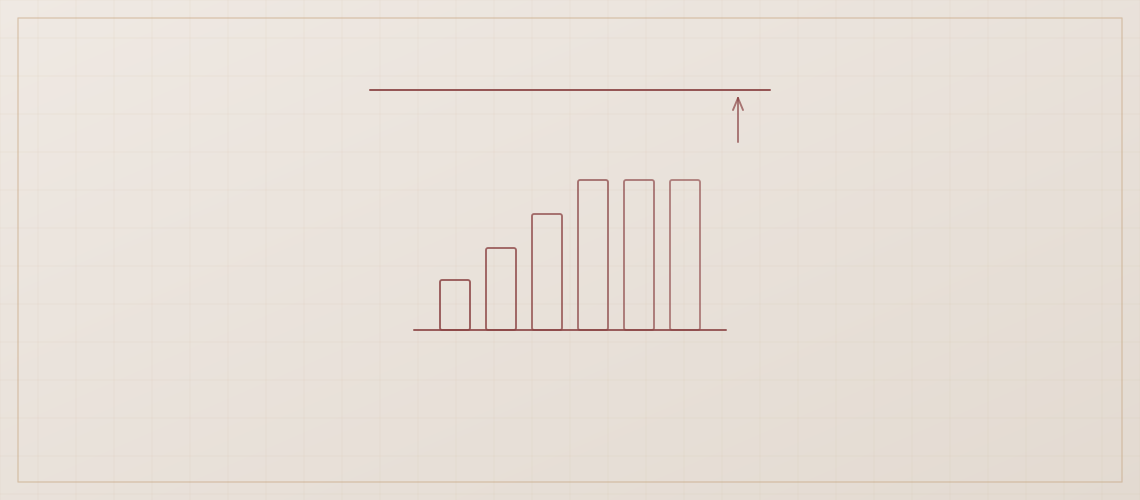
The severance ceiling is the upper limit on the amount payable for one year of service; however high the wage, no employee receives more than that figure per year. It is updated each January and July in line with the civil service pay coefficients. Below the ceiling, the calculation is made on the all-inclusive gross wage.
The ceiling matters most to higher-paid employees, and it is where severance calculations most often go wrong.
What the Ceiling Is
The severance ceiling is the maximum gross daily wage that may be taken into account in calculating severance, whatever the employee's actual wage. It is set under art. 14 of the former Labour Act No. 1475 and is limited to the maximum retirement gratuity payable to the highest-ranking civil servant.
"Collective or individual employment contracts may provide that the annual amount of the compensation shall not exceed the maximum retirement gratuity payable to the highest civil servant for one year of service."
Labour Act No. 1475, art. 14
How It Is Updated
The ceiling is revised twice a year — in January and July — in line with the civil service pay coefficient. The current figure is published by the Ministry of Labour and Social Security.
The practical effect: if your gross monthly wage is 60,000 TL but the ceiling is set at 45,000 TL, severance is calculated on 45,000 TL, not on 60,000 TL. For higher earners this is a substantial loss.
Which Payments Count
The gross wage used is not the basic salary alone. It includes:
- Basic salary under the contract;
- Meal allowance paid regularly in cash;
- Transport allowance paid in cash;
- Regular payments — premiums, bonuses and social benefits paid every month;
- Housing allowance paid in cash.
What is not counted: one-off annual bonuses (because they lack continuity), overtime pay, annual leave pay, and discretionary increases and awards.
| Payment | Counted? |
|---|---|
| Regular transport allowance | Yes |
| Meal allowance or meal card | Yes |
| Regularly paid bonuses and premiums | Yes |
| Fuel, clothing and education allowances | Yes |
| Private health insurance premium paid by the employer | Yes |
| Overtime pay | No |
| Annual leave pay | No |
| One-off, incidental payments | No |
| Travel and business trip expenses | No |
The test is not the name of the payment but its continuity: payments made monthly or at regular intervals enter the all-inclusive wage.
How Severance Is Calculated
- Thirty days' gross wage for each full year of service;
- Part years are pro-rated by days;
- The result may not exceed the ceiling.
An employee with five years' service on 30,000 TL gross a month has a gross daily wage of 1,000 TL. If that is below the ceiling, one year's severance is 1,000 × 30 = 30,000 TL, and five years is 150,000 TL.
Where the calculated daily wage exceeds the ceiling for that period, the ceiling figure is used instead.
Deductions
Severance pay is exempt from income tax up to the ceiling amount, and no social security premium is deducted. Only stamp duty is taken, so the net figure is close to the gross.
An employer cannot pay severance above the statutory ceiling. Even where a collective or individual contract provides for more, the ceiling governs and the excess is legally ineffective as severance — which is why collective agreements for higher earners provide separate contractual compensation instead.
Whether a payment enters the all-inclusive wage depends not on what it is called but on whether it is made regularly. Meal and transport allowances, regular bonuses and employer-paid health insurance count; overtime, annual leave pay and one-off payments do not.
Frequently Asked Questions
What is the severance ceiling?
The maximum amount payable for one year of service, whatever the employee's wage. It is updated each January and July.
My wage is above the ceiling. What happens?
Severance is calculated on the ceiling figure rather than your actual wage.
Which payments are included in the wage?
Those made with continuity — meal and transport allowances, regular bonuses, employer-paid health insurance. Overtime and annual leave pay are excluded.
Is severance taxed?
It is exempt from income tax up to the ceiling and free of social security premiums; only stamp duty is deducted.
Can my employer pay more than the ceiling?
Not as severance. The excess is legally ineffective, which is why higher earners are given separate contractual compensation instead.